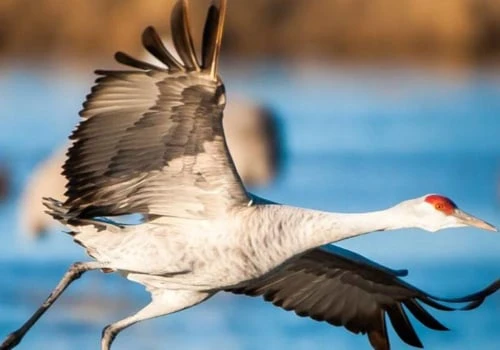
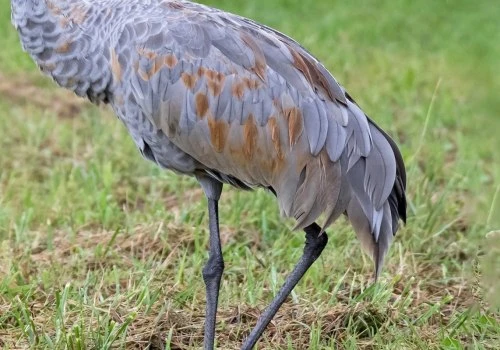
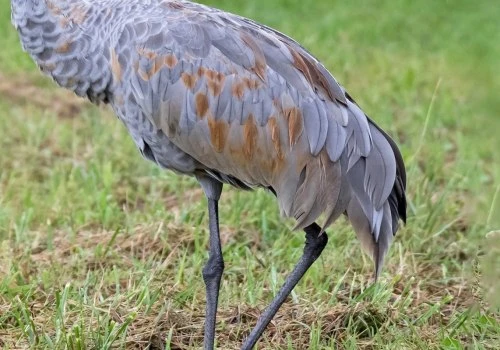
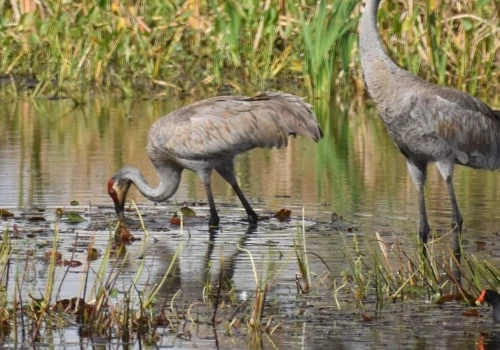
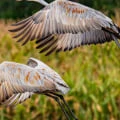
The world of sandhill cranes, or Grus canadensis, is one that has captivated people for centuries. These majestic birds are known for their impressive dancing skills, their opportunistic eating habits, and their incredible migratory patterns. Sandhill cranes are gray birds with long legs and long necks, similar to herons. They can be identified by the patch of bald and red skin on the top of their heads.
These birds are also distinguished by their flying style; they fly with their necks extended like geese, while herons fly with their necks tucked in their backs. Sandhill cranes are omnivorous and enjoy a variety of food sources. They typically feed on plants and grains, but they also consume invertebrates, small mammals, amphibians, and reptiles. Most sandhill cranes live in freshwater wetlands, such as swamps, wet grasslands, and river basins.
However, they can also be found in agricultural areas where they may cause significant damage to crops. The largest congregation of sandhill cranes is found from February to early April along the Platte River in Nebraska. This is believed to be due to the fact that the link between sandhill cranes and the Platte River dates back to the origins of the river about 10,000 or 12,000 years ago. During this time, more than 500,000 sandhill cranes converge in the Platte River basin to rest and eat before continuing on their migration to their breeding grounds in the north.
In late spring, summer, and early fall, sandhill cranes can be seen in their breeding areas. During this time, they build nests made of mats of vegetation about two feet in diameter and in shallow water. One of the most beautiful natural phenomena in the United States is the annual congregation of sandhill cranes along the Platte River in Nebraska. During this time, these birds groom themselves by rubbing their feathers with mud which gives them a reddish hue.
The total population of all subspecies exceeds one million, with small cranes being the most abundant.Unfortunately, sandhill cranes face threats due to degradation or direct loss of habitat due to the drainage of wetlands or the conversion of prairies for development or agricultural use. A fossil from the Miocene era, about ten million years ago, was discovered to have the same structure as the modern sand crane. This discovery further highlights how special these birds are and how long they have been around.